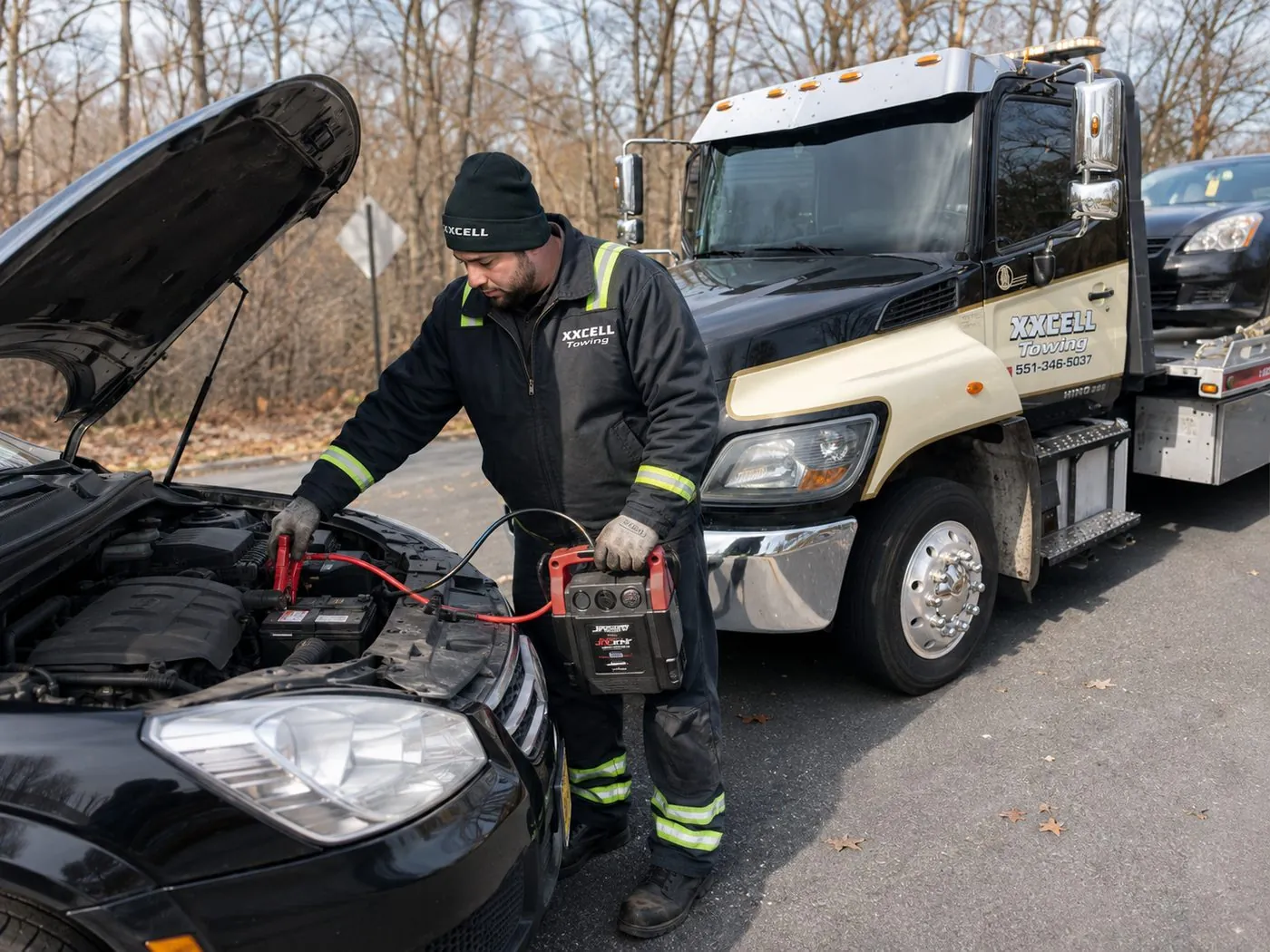
You finish shopping in Paramus, walk back to your car, and press the start button. The dashboard flickers. You hear clicking, but the engine never starts.
You try again. Same result.
Now you have a decision to make: do you need a jump-start, or does your vehicle need to go to a repair shop?
A car that will not start does not automatically need towing. However, assuming every starting problem is a dead battery can leave you requesting the wrong service. Here is how to handle this situation, step by step, while giving your roadside assistance provider the information needed to help.
Step 1: Check your surroundings before checking the car
In our example, your vehicle is parked in a shopping center. Leave it secured in its parking space while you assess the situation. Avoid pushing it into a driving lane to make it easier for a service truck to reach.
If your car is blocking an entrance or sitting where other drivers may not see it, explain that immediately when requesting assistance.
A vehicle stopped in moving traffic presents a different situation. If there is an immediate danger, contact emergency services. Do not stand in a traffic lane or attempt repairs where passing vehicles put you at risk.
Step 2: Notice exactly what happens when you try to start
Before making repeated attempts, pay attention to the sound, dashboard lights, and messages.
Does the engine turn over slowly? Do you hear rapid clicking? Does the dashboard stay dark? Or does the engine turn over normally without starting?
These details help narrow down the problem. Clicking or slow cranking can point toward a weak battery or a connection issue, but those symptoms do not prove the battery is the cause. A starter problem can also prevent the engine from turning over.
If the engine cranks normally but never starts, the problem may involve something beyond battery power. Describe what happens instead of guessing which part needs replacement. AAA: Reasons a car may not start
Step 3: Check the simple things from the driver’s seat
With the vehicle stationary and secured, confirm that an automatic transmission is fully in Park. Follow your vehicle’s normal starting procedure, including pressing the brake pedal if required.
Look for a “key not detected” message. A key-fob issue can prevent starting even when the vehicle battery has power. Your owner’s manual may describe a backup method for recognizing the key.
Switch off unnecessary accessories, such as the radio, climate controls, and interior lights.
Avoid repeatedly holding the key or pressing the start button. If the car still will not start after checking the basics, stop and arrange assistance. These observations help dispatch understand the situation; they do not replace a diagnosis.
Step 4: Know when to leave the battery alone
You do not need to connect jumper cables yourself before calling for help.
If you notice smoke, a strong sulfur-like smell, a swollen battery case, or visible leakage, stop troubleshooting and tell the provider. Do not attempt to jump-start a visibly damaged or potentially frozen battery.
Battery locations and approved jump points vary between vehicles. If you are unfamiliar with your vehicle’s procedure, leave the connection work to a qualified professional.
Hybrids and electric vehicles also require model-specific instructions. Tell dispatch exactly what you drive rather than assuming every vehicle can be handled the same way. AAA: Jump-start safety
Step 5: Give dispatch a location someone can actually find
“Near the mall in Paramus” leaves too much room for confusion.
Provide the shopping center’s name, street address, nearest store entrance, and parking section. Describe your vehicle’s color and share a location pin if requested.
For example: “I’m in the outdoor parking lot near the main entrance, beside the cart return. The vehicle is a gray SUV.”
If you are in a garage, mention the level, posted clearance, and whether the vehicle is parked nose-first against a wall. Access can affect which equipment can reach you and how the service must be performed.
Step 6: Explain the symptoms and request the appropriate help
You do not have to diagnose your vehicle over the phone. Give a clear description:
“My car won’t start. The dashboard lights come on, but I hear repeated clicking. It is parked outside, I have the key, and I have not tried a jump-start.”
Provide the year, make, and model. Mention any previous jump-start attempts and whether the car recently stalled while driving.
Ask whether a jump-start service is appropriate and what happens if it does not work. Confirm availability, the estimated arrival time, and pricing before authorizing service.
Also ask whether an unsuccessful jump-start and a subsequent tow would involve separate charges.
Step 7: Prepare while you wait
Keep your phone available so the operator can reach you. Gather your keys and any information you will need if the vehicle goes to a repair shop.
Choose a possible destination before a tow becomes necessary. Call the shop to confirm that it can accept the vehicle and ask about after-hours drop-off instructions if needed.
Let dispatch know about locked steering, an electronic parking brake that will not release, flat tires, or limited space around the car.
Do not force the shifter or release the parking brake to prepare for loading. Wait for the operator’s instructions.
Step 8: Decide what comes next after assistance arrives
If the vehicle starts after a jump, that does not establish why the battery lost power or guarantee that the car will restart later.
Arrange a battery and charging-system check. Ask whether the vehicle’s condition supports driving directly to a repair facility. Do not rely on an arbitrary number of minutes of idling as proof that the problem is resolved.
If the engine stalls, a charging warning remains illuminated, or the vehicle still will not start, further diagnosis and towing may be necessary. AAA: Safe jump-starting and battery care
Need help with a car that won’t start?
Contact XXCELL Towing with your Bergen County location, vehicle details, and symptoms. Whether you are parked in Paramus, at home in Westwood, or outside work in Hackensack, clear information helps us discuss the appropriate service, access requirements, and next steps before assistance is dispatched.
Related Resources